
Anthropic Releases FlashProve: Cryptographic Proofs That a Reply Came From Committed Weights
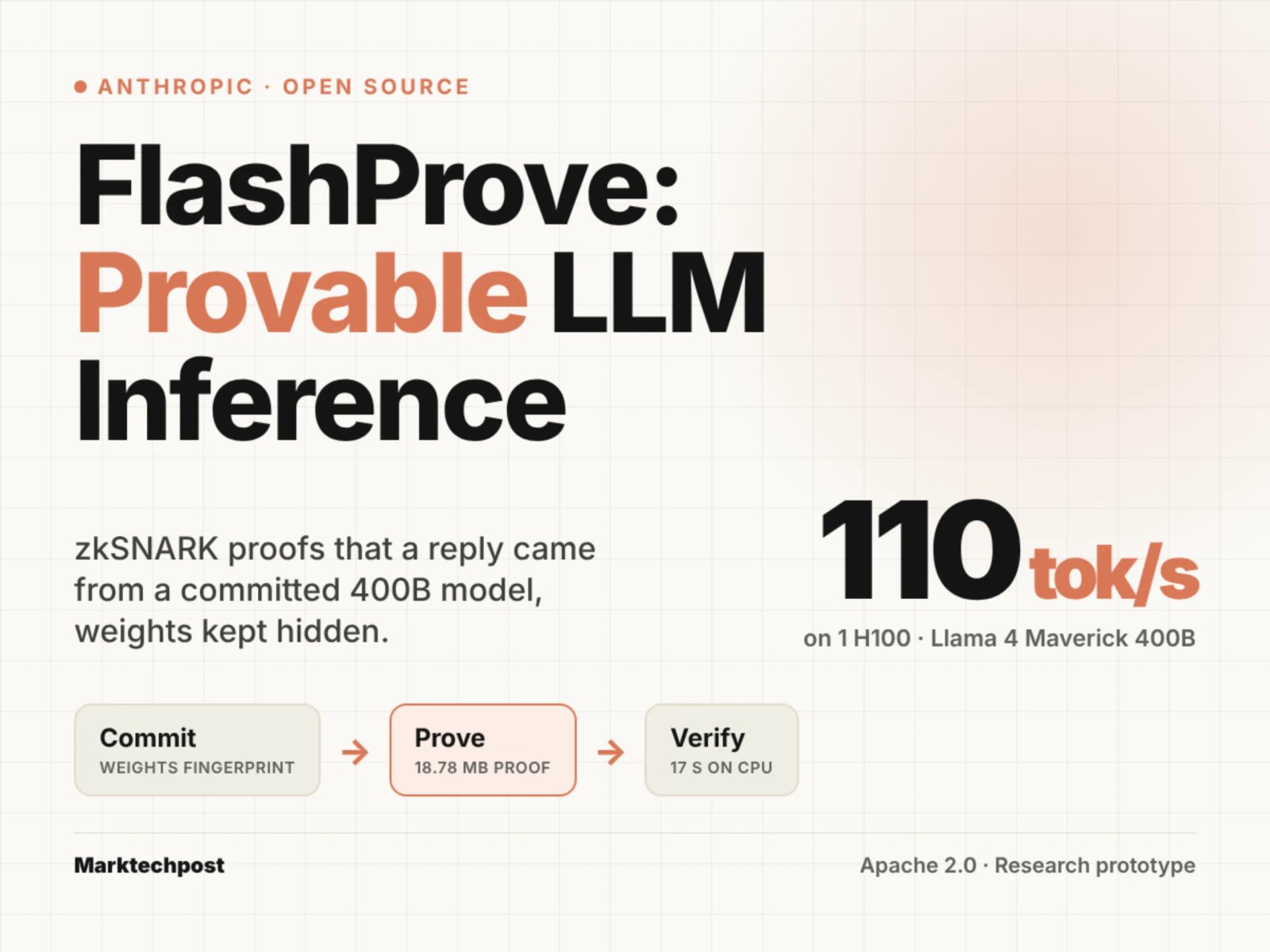


Anthropic’s Frontier Red Team has released FlashProve, an open-source research prototype for provable inference. FlashProve is a zkSNARK system from Anthropic that proves a reply came from a committed model. The proof reveals nothing about the model weights. On Llama 4 Maverick, a 400B mixture-of-experts model, it proves about 110 tokens/second on 1 H100. For developers, this targets a real gap: today you cannot check which model actually answered your API call.
TL;DR
- Size: Proves a 400B MoE model (~17B active per token); context capped at 1,024 tokens per request.
- Runs on: Prover needs 1 H100 80 GB, 24 CPU cores and ~290 GB host RAM. Verifier runs on a CPU, no GPU.
- Performance: Orders of magnitude faster than prior open-source zkML systems on the same 400B model.
- Best: 110 tokens/second proving on 1 H100, with 18.78 MB proofs checked in 17 seconds.
- Worst: Proving costs ~70 to 95x the GPU time of plain vLLM inference.
What problem does provable inference solve?
A user querying a model cannot verify which model produced the response. A routing service could swap in a cheaper model. An attacker could tamper with the token stream. Judging from output quality alone is unreliable.
Anthropic lists 4 use cases:
- Regulators could confirm hardware serves inference, supporting AI pacing rules.
- Labs could detect tampered inference servers.
- Users could verify text provenance.
- Regulators could enforce serving of approved models only.
How does FlashProve work?
FlashProve has a prover (the model provider) and a verifier (the user). It runs in 2 phases:
- Offline: The provider publishes a commitment, a short fingerprint binding one exact set of weights. This takes about 39 minutes and covers about 16 million requests.
- Online: For each request, the GPU produces a proof that the committed model produced those tokens.
The proof system compiles an interactive oracle proof into a cryptographic proof using hash functions. Anthropic says this offers post-quantum security. It is the same family used by validity-proof L2 networks such as Starknet.
Three engineering choices drive the speed. Prover work scales with the ~17B active parameters, not all 400B. Requests are proved in batches after the fact, like prefill. Weights stream from host memory, so a single 80 GB GPU suffices.
How fast is it? Benchmarks
Anthropic measured the public 4-bit Maverick weights on 1 H100 with 24 CPU cores. Per the repo performance guide:
- Batch of 24: 111.23 tokens/second, ~221 to 226 seconds per batch.
- Batch of 1: 17.41 tokens/second. Batch of 64: 123.31 tokens/second, flagged as unreliable on 80 GB cards.
- Proof size: 18.78 MB. Client downloads ~6.5 MB once per commitment.
- Verification: 17 seconds on 24 threads, 21 seconds on 1 thread.
Against vLLM running FP8 Maverick on 8 H100s, proving costs about 72x the GPU time per batch. At vLLM’s highest tested load, the gap is about 94x.
How does FlashProve compare with other zkML systems?
How is the security checked?
Cryptographic code is brittle, so Anthropic formalized the protocol in Lean. It proves completeness, soundness and zero knowledge. The README states a cheating provider is caught except with probability about q/2^124 + 2^-101.
FlashProve ships 2 verifiers. A fast C++ verifier is for daily use but carries no formal guarantee. A slower Lean verifier is proven to accept only what the soundness theorem accepts. Anthropic team notes Claude helped optimize the system.
Key Takeaways
- FlashProve proves a 400B MoE model at ~110 tokens/second on 1 H100.
- Proofs are 18.78 MB and verify on a CPU in 17 seconds.
- Proving costs ~70 to 95x the GPU time of vLLM inference.
- Security properties are formalized in Lean; weights stay hidden.
- Limited to 1,024 tokens, greedy decoding, and MoE models for now.
Check out the research post, technical report, protocol specification and GitHub repo. Also, feel free to follow us on Twitter and don’t forget to join our 150k+ML SubReddit and Subscribe to our Newsletter. Wait! are you on telegram? now you can join us on telegram as well.
Need to partner with us for promoting your GitHub Repo OR Hugging Face Page OR Product Release OR Webinar etc.? Connect with us
Asif Razzaq is the CEO of Marktechpost AI Media Inc.. As a visionary entrepreneur and engineer, Asif is committed to harnessing the potential of Artificial Intelligence for social good. His most recent endeavor is the launch of an Artificial Intelligence Media Platform, Marktechpost, which stands out for its in-depth coverage of machine learning and deep learning news that is both technically sound and easily understandable by a wide audience. The platform boasts of over 2 million monthly views, illustrating its popularity among audiences.



