
Banking lobby attempts to kill Clarity Act’s stablecoin progress as markup is scheduled for next week
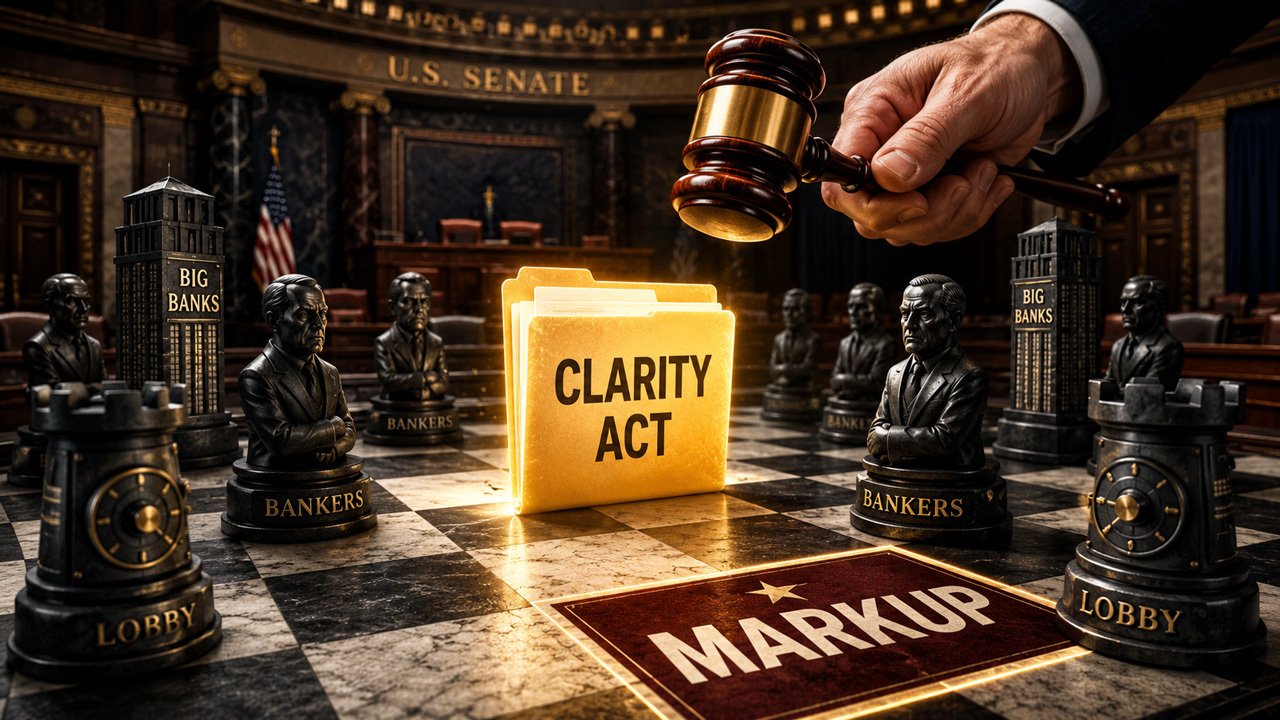




US banks are mounting an aggressive lobbying effort to stall the CLARITY Act, even as key US lawmakers signal a fast-tracked timeline to put the bill on the president’s desk before July 4.
The legislative clash centers on the Digital Asset Market Clarity Act, a sweeping regulatory framework that cleared the House with bipartisan support in July 2025.
For months, the bill has been bogged down in the Senate over a highly contentious provision regarding stablecoins and whether digital asset firms can offer yield to customers.
While a recent bipartisan compromise aimed to clear this roadblock, the banking sector is now publicly rejecting the drafted language, arguing it threatens the foundation of local lending and risks widespread capital flight.
Despite the friction, proponents of the bill on Capitol Hill are projecting confidence. Bolstered by the anticipated support from the Trump administration, Senate negotiators are holding firm against the banking lobby, setting the stage for a critical committee markup the week of May 11.
The stablecoin yield loophole and fears of deposit flight
The core of the dispute lies in how the CLARITY Act regulates yield-bearing payment stablecoins.
A coalition of major trade groups, including the American Bankers Association, the Bank Policy Institute, the Consumer Bankers Association, the Financial Services Forum, and the Independent Community Bankers of America, issued a joint front this week criticizing the language drafted by Senators Thom Tillis and Angela Alsobrooks.
While the banking groups acknowledged the senators’ overarching policy goal to prohibit the direct payment of yield and interest on stablecoins, they claim the current text of Section 404 is riddled with loopholes.
The coalition argues that the legislation still permits digital asset exchanges and intermediaries to distribute rewards tied to membership programs, provided they are not calculated or distributed in the same way as traditional bank interest.
For the legacy financial sector, this is a distinction without a difference.
The trade groups argue that allowing crypto firms to calculate permissible rewards based on customer duration, account balances, and tenure overtly incentivizes the idle holding of stablecoins. Traditional institutions rely on those idle funds remaining in deposit accounts to finance community growth.
According to the coalition’s internal research, the proliferation of yield-earning stablecoin alternatives could siphon off enough liquidity to reduce available capital for consumer, small-business, and agricultural loans by as much as 20%.
Meanwhile, market intelligence indicates a growing divide within the broader financial sector regarding this pushback.
While retail-facing megabanks and community lenders remain vehemently opposed to the compromise, institutions without massive consumer deposit arms are showing signs of cautious comfort with the Tillis-Alsobrooks framework.
Senate negotiators refuse to back down
Faced with the prospect of their compromise unraveling, lawmakers are pushing back against the banking lobby’s demands.
Senator Tillis, who spearheaded the stablecoin provision, defended the drafted language as a hard-fought, balanced product that successfully neutralizes the specific threat of deposit flight without suffocating industry innovation.
Tillis noted that the banking industry was not blindsided by the text, stating that traditional financial stakeholders have had a seat at the negotiating table for months to offer direct feedback.
The current text, he argued, explicitly prohibits stablecoin rewards from functionally mimicking bank deposit interest.
While it allows digital asset companies to utilize other operational reward structures, Tillis warned against letting the pursuit of a flawless bill derail the broader regulatory certainty the industry desperately requires.
The senator’s remarks highlighted a growing frustration on Capitol Hill with the banking sector’s shifting goalposts.
He suggested that certain factions within traditional finance may simply oppose the passage of the CLARITY Act altogether, viewing the stablecoin yield debate not as a policy flaw, but as a convenient mechanism to stall the legislation indefinitely.
Crypto industry analysts echo this sentiment. Alex Thorn, head of research at Galaxy Digital, noted that Tillis absorbed significant criticism from the digital asset sector for bringing banks into the negotiation process in the first place.
With the banking coalition now rejecting the resulting concessions, Thorn argued the move exposes an underlying strategy of obstruction.
The prevailing view among crypto market analysts is that the banking lobby’s primary objective is to delay and deny the regulatory framework entirely, rather than constructively amend it.
A ticking clock for Senate action
While the lobbying battle intensifies off the floor, the timeline for advancing the legislation is accelerating rapidly.
Senator Cynthia Lummis, chair of the Senate Banking Subcommittee on Digital Assets, recently issued a stark call to action, demanding an end to the years of regulatory ambiguity that have forced domestic digital asset firms to operate in the shadows.
Lummis emphasized that the broader market-structure language, alongside the contentious stablecoin provisions, is finalized. She stated:
“The digital asset industry has waited long enough. Businesses are making decisions where to build RIGHT NOW, and without clear rules, too many will go overseas. We must get Clarity done now. America’s financial future depends on it.”
Notably, Senate Banking Chairman Tim Scott has publicly confirmed that the lawmakers are “working toward a bipartisan markup in May to advance digital asset market structure.”
That urgency was reinforced by Senator Bernie Moreno during a recent address at the Solana Accelerate USA conference.
Pointing to the legislative momentum generated by the successful passage of the GENIUS Act, Moreno projected that the Senate will move the CLARITY Act through committee in the coming weeks.
His ultimate target is to coordinate the necessary cross-panel jurisdictions and deliver a finalized legislative package to President Donald Trump’s desk before the end of June.
Moreno framed the upcoming committee markup as a decisive moment for the US economy, noting that combining various oversight provisions into a single, floor-ready package remains the final major procedural hurdle.
Market optimism and structural stakes
The stakes for the US digital asset ecosystem are immense.
The CLARITY Act is designed to fundamentally restructure how the government interacts with digital markets, drawing long-awaited jurisdictional boundaries between the Securities and Exchange Commission (SEC) and the Commodity Futures Trading Commission (CFTC).
Beyond stablecoin regulations, the bill attempts to establish clear operational standards for asset custodians, decentralized finance (DeFi) participants, and exchange platforms, offering critical safe harbors for network validators and node operators.
Proponents of the legislation argue that failing to pass the bill before the August recess could result in permanent capital flight, effectively ceding US dominance in the digital asset space to overseas jurisdictions.
Despite the friction from the banking lobby, market sentiment is trending overwhelmingly positive. Prominent industry executives, including Ripple CEO Brad Garlinghouse and Coinbase CEO Brian Armstrong, have recently noted a massive structural shift in legislative optimism.
That sentiment is reflected in digital prediction markets, which currently price the odds of the CLARITY Act becoming law in 2026 at over 60%.
As the May 11 markup approaches, the coming weeks will test whether bipartisan momentum can finally overpower legacy financial resistance.



